

Last Updated: May 2026
Every result on the first page of “club management software” is written by a vendor reviewing themselves. Wild Apricot ranks itself well, Join It ranks itself first, and Jersey Watch only covers youth sports. None of them mention that Wild Apricot and MemberClicks now share the same private equity owner, that most “AI features” in this category are still slideware, or that the right tool for a 60-member tennis club is almost never the right tool for a 5,000-member trade association.
This guide does the work those reviews skip. We list 20 club management software platforms, including Raklet, and tell you when not to choose each one. We cover the 2026 ownership shake-up that is changing pricing and support across the category. And we say plainly which AI features are running in production today and which are still on a roadmap slide.
According to ASAE and Oxford Economics, US associations and clubs support $42 billion in community spending each year (August 2024). Picking the right platform protects that spending. Picking the wrong one creates years of migration debt.
What Is Club Management Software?
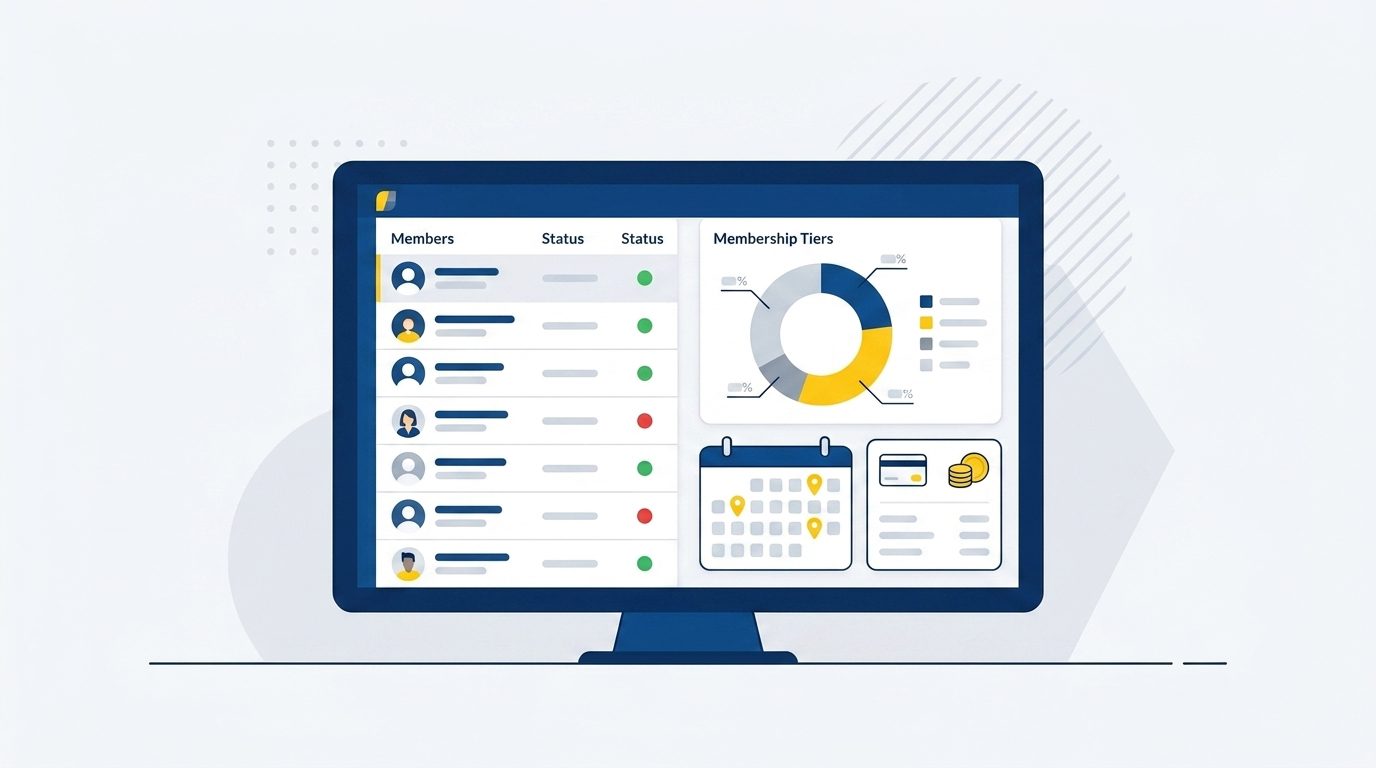
Club management software is a single platform that handles membership records, dues collection, event registration, communication, and member self-service. It replaces the patchwork of spreadsheets, payment links, mass emails, and shared inboxes that small clubs typically start with.
Most platforms in the category bundle five core capabilities into one login: a member database with custom fields and tiers, recurring billing for dues and renewals, an events module with ticketing and check-in, an email or SMS engine for member communication, and a member portal where members update profiles, pay dues, and register for events without staff help.
The line between club management software and a CRM is thin but useful. A general CRM (Salesforce, HubSpot) tracks relationships and pipeline stages. Club management software is built around the member lifecycle: join, pay, renew, attend, lapse, win back. If your team spends most of its time on dues and events, a CRM will make you build everything from scratch. A purpose-built club management system delivers those workflows pre-configured, so the team starts from a working setup rather than a blank schema.
Sports clubs, hobby clubs, professional associations, alumni networks, private and country clubs, and small nonprofits are the typical buyers. The 501Works AMS Survey (n=241, 2023) found that 51% of organizations switched their membership platform because the legacy tool became insufficient, not because they wanted a fancier feature set. That is the buying trigger to plan around.
What Features Should Club Management Software Have?
The exact feature mix depends on club type, but every credible platform should cover the seven categories below. Use this list as the floor when comparing demos. Anything missing should be a fast disqualifier.

Member database and profiles
Custom fields, multiple membership tiers, household or family groupings, join date and renewal date tracking, and segmentation by tag or status. A platform that limits you to a fixed schema will become the bottleneck within a year.
Dues and payment processing
Recurring billing, automatic renewals, dunning emails for failed cards, partial refunds, and prorated upgrades or downgrades. Pay close attention to the payment processor: many platforms force you onto Stripe at standard processing rates, while a few support multiple processors or pass-through fees.
Event management
Public and member-only events, paid ticketing, capacity caps, waitlists, attendance check-in (often via QR code or mobile app), and recurring event series. Event modules vary widely in depth. A small monthly social event needs less than a multi-week tournament with brackets.
Communication tools
Email campaigns to segments, transactional emails (renewal reminders, receipts), SMS or push notifications for time-sensitive updates, and ideally a private community feed or forum so members talk to each other rather than only to staff.
Reporting and analytics
Member growth, churn, revenue by tier, event attendance trends, and the ability to export raw data. The best tools also include a renewal forecast and at-risk member view. According to the 2025 iMIS Membership Performance Benchmark (n=200+), 65% of associations plan AMS or CRM investment in 2025, often because their current reporting cannot support board-level conversations.
Mobile app
Two distinct apps to evaluate: an admin app for staff to check members in at events, and a member-facing app for self-service. A few platforms only ship one or the other. For sports and fitness clubs, a member-facing app is close to mandatory.
Integrations (and the AI Question)
Zapier, QuickBooks, Stripe, Mailchimp, and SSO providers cover most cases. Salesforce or Microsoft Dynamics matter for larger associations. AI is now showing up in payment prediction, member engagement scoring, and natural language reporting, but as of 2026 most marketing claims about AI are still aspirational. Ask vendors which AI feature is running in production for paying customers, and which is on a roadmap slide.
How to Choose Club Management Software
The five steps below cover the questions buyers ask in vendor demos but rarely write down. Working through them before booking demos prevents the most common mistake in this category: signing a multi-year contract for a tool sized to the wrong segment.
Define your club type and size
A 60-member tennis club has almost nothing in common operationally with a 5,000-member professional association. Sports clubs need scheduling, attendance, and parent communication. Associations need chapter support, certifications, and accounting integrations. Private clubs need POS for the bar and dining room. List your three most-used workflows, then use those as the demo script. For very small clubs, see our in-depth club software guide for a narrower set of options that fit clubs under 200 members.
Set a realistic budget
Pricing in 2026 typically falls into three ranges. Entry-level generalist tools run $40 to $160 per month. Mid-market single-site clubs spend $150 to $500 per month. Enterprise private clubs and large associations often pay $1,000 to $5,000+ per month. Per-member pricing models (common at ClubExpress and many sports tools) charge $0.30 to $0.42 per member per month. Read the contract before signing: per-member pricing can look cheap at 100 members and become expensive at 1,500.
Check who owns the company
Private equity has consolidated this category fast. In January 2026, Momentive Software (a TA Associates portfolio company) acquired Personify, adding Wild Apricot to a platform that already included MemberClicks, YourMembership, and other legacy AMS brands. MemberLeap was acquired by Valsoft Corp in April 2026. Combined, these moves affect 37,000+ client organizations. Post-acquisition pricing changes and support degradation are common. Ask every vendor: who owns you, who owned you two years ago, and what does the public roadmap look like for 2026 and 2027? If they will not answer plainly, treat that as a signal.
Ask about the AI roadmap
Almost every vendor in 2026 has an AI page on their website. Almost none of them have an AI feature that paying customers use weekly. Ask for a live demo of the AI feature with a real customer dataset. If the rep can only show a recorded video, the feature is not in production. As of mid-2026, only a handful of platforms ship AI features that are actually used: Club Caddie’s Looper AI for natural language analytics, Cobalt Software’s Member Concierge for member-facing assistance, and a few payment-prediction features in fitness platforms.
Free trial vs. annual contract
Most modern SaaS tools offer a 14 to 30 day free trial. A growing number of legacy AMS vendors will only sell on annual contracts after a sales-led demo. The legacy contract path is fine for established associations that already know their requirements. For everyone else, a free trial that lets you import a sample of real members and run one event end-to-end is the fastest way to avoid a bad fit.

Top 20 Club Management Software of 2026
The 20 platforms below are ordered by breadth and depth of membership management capabilities, not by revenue or paid placement. Each entry covers what the tool is, the features that matter, current pricing, the club type or size it actually fits, and the limitations vendors do not advertise.
1. Raklet
Disclosure: Raklet is our product. We have positioned it first because that is our recommendation, not because of editorial neutrality. The limitations section below is honest.
Overview: Raklet is an all-in-one membership platform for clubs, associations, alumni networks, and nonprofits. It combines a member CRM, recurring dues, events, email and SMS campaigns, and a private community feed in a single workspace, with a free starter plan and contact-based pricing as you scale.
Key features:
- Custom membership tiers, application forms, and approval workflows
- Stripe-powered recurring dues with dunning, plus invoicing for organizations that prefer offline payments
- Built-in events module with paid tickets, capacity caps, and QR check-in
- Native member app (iOS + Android) with branded white-label option on higher tiers
Pricing: Free plan available. Paid tiers begin in the entry-level range and use a contact-based model with optional add-on packs. Final pricing depends on contact count and add-ons.
Best for: Hobby clubs, alumni networks, professional associations, and small nonprofits between 50 and 5,000 members that want one platform instead of stitching tools together.
Limitations: Raklet is not built for fitness chains with class scheduling and POS. If your primary workflow is per-class billing or lane reservations, a vertical tool will fit better. The community feed is more lightweight than dedicated forum platforms. Support is via chat and email only; no phone line is available. The public API is available but documentation is self-service, which may require developer time for deep integrations.
2. Wild Apricot
Overview: Wild Apricot is one of the longest-running platforms in the category, covering small to mid-sized associations, clubs, and nonprofits. It bundles website, member database, events, and dues into one product. Since January 2026 it has been part of Momentive Software (backed by TA Associates), which also owns MemberClicks, YourMembership, and several other legacy AMS brands.
Key features:
- Website builder with member-only pages
- Member database with custom fields and bundled memberships
- Events module with paid registration
- Email campaigns and member directories
Pricing: Free plan for up to 50 contacts. Paid plans scale by contact count, typically $60 to $720+ per month.
Best for: Small associations and clubs already on Wild Apricot, where switching cost outweighs feature gaps.
Limitations: Trustpilot rating sits at 1.6/5 across recent reviews, with consistent complaints about support response times since the acquisition. The website builder is dated, AI features promised pre-acquisition have stalled, and pricing has shifted upward in 2025–2026 reviews. New buyers should evaluate alternatives before signing a multi-year contract.
3. ClubExpress
Overview: ClubExpress is a long-standing US platform built for hobby, social, and professional clubs. It covers websites, membership management, dues, events, and discussion forums, with a focus on clubs that have multiple committees and chapters.
Key features:
- Multi-chapter and multi-committee structures
- Dues with automatic renewals and prorating
- Member directories, forums, and email distribution lists
- Per-member pricing rather than tiered packages
Pricing: Per-member, typically $0.30 to $0.42 per member per month, with monthly minimums.
Best for: Long-established US clubs (alumni associations, social clubs, professional groups) with 200 to 5,000 members and complex committee structures.
Limitations: The interface is functional but dated. Mobile experience for members is weaker than newer competitors. AI features are not part of the public roadmap as of 2026.
4. MemberPlanet
Overview: MemberPlanet targets membership groups, alumni associations, PTAs, and Greek organizations with a hosted member database, dues, broadcasts, and group fundraising. It is one of the more affordable mid-market options.
Key features:
- Member database with custom fields and tiers
- Group SMS and email broadcasts
- Online dues collection with multiple payment options
- Built-in fundraising campaigns
Pricing: Free starter plan. Paid plans begin around $50 per month and scale with members and features.
Best for: PTAs, alumni groups, and Greek organizations that need fundraising plus a member directory.
Limitations: Event management is functional but not deep enough for ticketed conferences or multi-track event programs. The reporting layer is light compared to enterprise AMS tools.
5. TeamUp
Overview: TeamUp is a class-based scheduling and membership platform popular with CrossFit boxes, martial arts gyms, and yoga studios. It centers on class scheduling, attendance, and recurring memberships rather than committees or chapters.
Key features:
- Class schedules with capacity and waitlists
- Recurring memberships and class packs
- Attendance tracking and check-in
- Branded mobile app for members
Pricing: Tiered by active customer count, typically starting at $99 per month for the first 50 active customers and rising in bands above that.
Best for: CrossFit, martial arts, and boutique fitness studios with 50 to 500 active members.
Limitations: Not designed for clubs without a class schedule. Reporting is fitness-centric. Event management for non-class gatherings is basic.
6. Hello Club
Overview: Hello Club is a New Zealand-built platform popular with sports clubs, particularly tennis, squash, racquet, and bowling clubs. It combines membership, court bookings, events, and member communication in a single product.
Key features:
- Court and resource booking system
- Membership management with custom tiers
- Online payments for dues and bookings
- Member-facing mobile app
Pricing: Tiered by member count, with a free tier for very small clubs and paid plans typically beginning around $30 to $60 per month for clubs under 100 members.
Best for: Racquet sports, bowling, and similar small-to-mid sports clubs that need court bookings alongside memberships.
Limitations: Light on email marketing and member engagement features. Not the right fit for associations with chapters, committees, or certification tracking.
7. ClubReady
Overview: ClubReady is a fitness-focused club management platform for boutique gyms, multi-location chains, and franchise concepts. It covers POS, member billing, sales pipeline, and class scheduling.
Key features:
- Sales pipeline and lead management for membership sales
- POS and recurring billing
- Class scheduling and attendance
- Multi-location reporting
Pricing: Sales-led, typically several hundred dollars per month per location, with setup fees.
Best for: Multi-location fitness franchises and boutique chains with 500+ members per location.
Limitations: Implementation is heavy. Smaller single-location clubs find it overpowered and expensive. The interface has accumulated complexity from years of feature additions.
8. Zen Planner
Overview: Zen Planner serves martial arts schools, affiliate gyms, yoga studios, and small fitness businesses. It is part of the Daxko portfolio, which also owns several other fitness brands.
Key features:
- Membership and class billing
- Attendance and skill tracking (popular with martial arts)
- Automated emails and renewals
- Member self-service portal
Pricing: From around $117 per month for the smallest tier, scaling up by member count and features.
Best for: Martial arts schools, affiliate gyms, and small studios with 100 to 750 members.
Limitations: Reporting is lighter than dedicated enterprise tools. Multi-location workflows are functional but not as deep as ClubReady or Perfect Gym.
9. Perfect Gym
Overview: Perfect Gym is a European-rooted enterprise fitness platform used by mid-market and large gym chains. It covers membership, billing, access control, mobile app, and analytics.
Key features:
- Multi-location membership and billing
- Access control integrations (turnstiles, lockers)
- Branded member app
- BI and reporting layer
Pricing: Sales-led, enterprise tier. Total cost typically several thousand dollars per month for multi-location deployments.
Best for: Mid-market and enterprise fitness chains with 5+ locations.
Limitations: Implementation is a multi-month project. Not viable for single-location clubs or any club without a dedicated operations manager.
10. GymMaster
Overview: GymMaster is a New Zealand-built gym management platform with 24/7 access control, billing, and a member portal. It is popular with small to mid-sized gyms in Australasia, the UK, and North America.
Key features:
- 24/7 door access integration
- Recurring billing and POS
- Member app with bookings
- Communication tools (email and SMS)
Pricing: Tiered by member count, starting around $99 per month for the smallest tier.
Best for: Single-location and small multi-location gyms, especially 24/7 access models.
Limitations: Outside fitness, the platform is the wrong shape. No chapter or committee structure. Reporting is fitness-specific.
11. EZFacility
Overview: EZFacility is a facility and program management platform used by sports complexes, indoor turf, ice rinks, and recreation centers. It handles bookings, leagues, memberships, and POS for facilities that rent space and run programs.
Key features:
- Facility and resource booking
- League and tournament scheduling
- Memberships and POS
- Online registration for programs
Pricing: Sales-led pricing; mid-market range for typical sports facilities.
Best for: Sports complexes, ice rinks, indoor turf, and rec centers running both memberships and bookings.
Limitations: Heavy interface. Setup time is significant. Not the right tool for clubs without a facility to book.
12. Hapana (formerly Clubworx)
Overview: Hapana is the rebranded successor to Clubworx, expanded in 2024–2025 into a multi-product fitness operating system covering memberships, marketing automation, and member apps. It serves boutique and mid-market fitness brands globally.
Key features:
- Member management and recurring billing
- Lead automation and CRM
- Branded member app
- Multi-location support
Pricing: Sales-led, with package tiers based on locations and feature set.
Best for: Boutique fitness brands and mid-market chains scaling beyond a single location.
Limitations: The Clubworx-to-Hapana transition has introduced naming and product-edition confusion in older help articles. Set expectations during sales calls about which features ship in your edition vs. require a higher tier.
13. YourMembership
Overview: YourMembership is a long-running association management system now under Community Brands ownership (the Clearlake Capital portfolio that consolidated several legacy AMS brands). It covers membership, dues, events, and a member community module.
Key features:
- Membership database with chapters and tiers
- Dues collection and renewals
- Events module
- Member community and job board
Pricing: Sales-led, mid-market enterprise pricing.
Best for: Mid-sized professional associations already invested in the Community Brands ecosystem.
Limitations: Like most legacy AMS tools post-acquisition, support and roadmap velocity have drawn customer concern. Implementation timelines are long. AI features are not in production as of 2026.
14. ClubManagerCentral
Overview: ClubManagerCentral is a UK-rooted platform for sports and social clubs, covering membership, payments, and events with a focus on simplicity over breadth.
Key features:
- Membership tiers and renewals
- Online payments
- Event management
- Member directories
Pricing: Tiered subscription, typically £20 to £100+ per month based on member count.
Best for: UK-based community sports clubs and small associations.
Limitations: Reporting and segmentation are basic. Limited integrations outside payments.
15. TeamSnap
Overview: TeamSnap is the dominant tool for youth sports teams, leagues, and clubs in the US. It focuses on rosters, schedules, parent communication, and registration. The Business tier expands into club and league management.
Key features:
- Team rosters and game schedules
- Parent and coach messaging
- Registration and payments
- Branded mobile app
Pricing: Free for basic teams. Paid tiers start around $11 per team per month, with TeamSnap for Business priced at the league or club level (sales-led, typically several hundred dollars per month).
Best for: Youth sports teams, recreational leagues, and small sports clubs.
Limitations: Not built for non-sports clubs. The free tier is intentionally limited; serious clubs end up on the Business tier where pricing climbs.
16. ClubSpeed
Overview: ClubSpeed is a niche platform for karting tracks, bowling alleys, trampoline parks, and family entertainment centers. It combines POS, membership, race management, and online booking.
Key features:
- POS and online booking
- Race timing and scoring (karting)
- Membership and loyalty programs
- Reporting for entertainment venues
Pricing: Sales-led, mid-market.
Best for: Karting, bowling, trampoline, and family entertainment center operators.
Limitations: Highly specialized. Outside its target verticals, the product is the wrong shape.
17. ClubManager
Overview: ClubManager is a UK-headquartered fitness and gym software covering membership, payments, class booking, and access control. It serves single-location and small chain operators.
Key features:
- Membership and direct debit billing
- Class booking and timetable
- Access control integrations
- Member app
Pricing: Tiered, typically starting in the £80 to £150 per month range for single-location clubs.
Best for: UK and European fitness operators wanting a localized direct debit workflow.
Limitations: Less brand recognition outside Europe. Reporting is functional but light compared to enterprise tools.
18. ClubHub
Overview: ClubHub is an Australia-built platform for sports clubs covering memberships, registrations, payments, and team management. It is popular with community sports federations. Note: the original public-facing site is currently offline; verify availability with the vendor before evaluating.
Key features:
- Membership registrations and renewals
- Team and squad management
- Online payments
- Communication tools
Pricing: Per-member or tiered subscription, sales-led at the federation level.
Best for: Australian and New Zealand community sports clubs and federations.
Limitations: Regional focus. Limited adoption outside Australasia. Integration ecosystem is smaller than larger US tools.
19. ClubRunner
Overview: ClubRunner serves service clubs (Rotary, Lions, Kiwanis), professional associations, and chambers of commerce. It covers websites, member directories, dues, events, and committees. Many Rotary districts standardize on it.
Key features:
- Service club templates and bulletins
- Member database with committees and roles
- Dues and event payments
- District-level rollup reporting
Pricing: Tiered by member count, typically $30 to $200+ per month.
Best for: Service clubs and chambers, especially Rotary, Lions, and Kiwanis chapters.
Limitations: Outside service-club workflows, the templates feel narrow. Mobile member experience is weaker than newer entrants. For a side-by-side breakdown, see ClubRunner vs Raklet.
20. Vagaro
Overview: Vagaro is a beauty, wellness, and fitness platform with strong booking, POS, and marketing tools. Many small fitness studios use it instead of a dedicated club tool because of the strong consumer marketplace.
Key features:
- Online booking and consumer marketplace
- POS and inventory
- Memberships and packages
- Marketing automation
Pricing: Tiered by booking calendars, typically $30 to $200+ per month.
Best for: Small wellness, salon, spa, and boutique fitness studios.
Limitations: Not a fit for non-commercial clubs (associations, hobby clubs, alumni networks). The marketplace orientation is a strength for studios and a distraction for membership organizations.
Club Management Software Comparison Table
The table below summarizes the 20 platforms across the dimensions buyers most often compare in early evaluation. Pricing reflects publicly listed plans where available; sales-led tools are noted as such.
| Tool | Starting price | Free plan | Mobile app | AI features (in production 2026) | Best for |
|---|---|---|---|---|---|
| Raklet | Free / contact-based paid tiers | Yes | Yes (member + admin) | Internal AI assists in active rollout | Clubs, associations, alumni, nonprofits 50–5,000 members |
| Wild Apricot | $60+/mo (50 contacts free) | Yes (50 contacts) | Yes (admin) | None in production | Existing customers; new buyers should evaluate alternatives |
| ClubExpress | $0.30–0.42/member/mo | No | Limited | None announced | Established US clubs with chapters |
| MemberPlanet | ~$50/mo (free starter) | Yes (limited) | Yes | None in production | PTAs, alumni, Greek life |
| TeamUp | $99+/mo (band by customers) | No | Yes (branded) | None in production | CrossFit, martial arts, yoga |
| Hello Club | ~$30–60+/mo | Free tier | Yes | None in production | Racquet, bowling sports clubs |
| ClubReady | Sales-led (multi-hundred/mo) | No | Yes | None in production | Multi-location fitness chains |
| Zen Planner | $117+/mo | No | Yes | None in production | Martial arts, affiliate gyms |
| Perfect Gym | Sales-led, enterprise | No | Yes (branded) | None in production | Mid–large fitness chains 5+ locations |
| GymMaster | ~$99+/mo | No | Yes | None in production | Single-location and small-chain gyms |
| EZFacility | Sales-led | No | Yes | None in production | Sports facilities, rinks, rec centers |
| Hapana | Sales-led | No | Yes (branded) | None in production | Boutique and mid-market fitness |
| YourMembership | Sales-led, mid-market | No | Limited | None in production | Mid-sized associations on Community Brands stack |
| ClubManagerCentral | ~£20–100+/mo | No | Limited | None in production | UK community sports and social clubs |
| TeamSnap | Free / $11+/team/mo | Yes (basic) | Yes | None in production | Youth sports teams and leagues |
| ClubSpeed | Sales-led | No | Limited | None in production | Karting, bowling, entertainment |
| ClubManager | ~£80–150+/mo | No | Yes | None in production | UK and EU fitness operators |
| ClubHub | Sales-led | No | Yes | None in production | Australasian community sports |
| ClubRunner | $30–200+/mo | No | Limited | None in production | Service clubs (Rotary, Lions, Kiwanis) |
| Vagaro | $30–200+/mo | No | Yes | None in production | Salon, spa, boutique fitness |
Free Club Management Software: What’s Actually Free?
“Free” in this category usually means a member-capped or feature-limited plan. Three platforms ship a genuinely usable free tier worth considering for very small clubs. The rest of the “free” mentions you will see are 14-day trials.
- Raklet offers a free plan covering core membership, payments, and events for small clubs starting out.
- Wild Apricot provides a free plan for up to 50 contacts. Beyond 50, paid tiers start at the entry level and rise quickly with contact count.
- TeamSnap has a free plan for individual youth sports teams, but anything club-level or league-level requires the paid Business tier.
- MemberPlanet ships a free starter tier with limited features.
Free plans are useful for proving out your workflow before committing budget. Plan to outgrow them within 6 to 12 months. One of the costliest mistakes in this category is migrating off the wrong tool later. A bad migration can take months and cost more than the price difference between platforms ever saved.
Club Management Software for Specific Club Types
The single biggest mistake in this category is comparing tools horizontally rather than by club type. The shortlist below splits the 20 platforms above (and a few specialists) by the segment they were actually designed for.

Sports clubs
For youth sports leagues and recreational teams, TeamSnap dominates. SportsEngine and LeagueApps cover larger leagues with multiple sports. EZFacility handles sports complexes that need booking plus memberships. For racquet and bowling clubs, Hello Club is purpose-built. Single-sport adult clubs (rugby, cricket, soccer) often standardize on regional federations’ preferred tools.
Golf clubs
Club Caddie, foreUP, and Lightspeed Golf lead the dedicated golf club software category. Club Caddie’s “Looper AI” went into production in April 2026 for natural language analytics, the first AI feature in this segment with paying customers using it weekly. Cobalt Software’s Member Concierge is also rolling out for private and country clubs.
Fitness and gym clubs
Choose by size. Single-location and small chains often pick Zen Planner, GymMaster, or TeamUp. Multi-location chains move up to Hapana, Perfect Gym, or ClubReady. For a deeper segment view, see the health club management software guide.
Tennis, racquet, and country clubs
Tennis clubs and racquet clubs need court bookings tied to memberships. Hello Club and Court Reserve cover the small-to-mid range. Larger country clubs with dining, POS, and dues for hundreds of members move to Cobalt Software, Clubessential, or Jonas. Raklet’s tennis club software page has a focused fit assessment for racquet-only clubs.
Social, hobby, and alumni clubs
This is the segment where Raklet, Hello Club, ClubRunner, and MemberPlanet compete most directly. The decision usually comes down to whether the club has chapters or committees (favoring ClubRunner or ClubExpress), needs a private community feed (favoring Raklet), or runs heavy fundraising (favoring MemberPlanet).
Private and country clubs
Private clubs have unique requirements (POS for dining and pro shop, locker management, gate access, billing for non-dues spending). Cobalt Software, Clubessential, and Jonas Club Software dominate this segment. None of the generalist tools above are appropriate for a country club operation at scale.
The 2026 Club Software Market: What Buyers Need to Know
Two trends are reshaping buyer decisions in 2026. Neither is mentioned on most vendor comparison pages because vendors have no incentive to flag them.
Private equity consolidation has accelerated. In January 2026, Momentive Software (backed by TA Associates) acquired Personify, adding Wild Apricot to a platform that already included MemberClicks, YourMembership, and several other legacy AMS brands , with a combined client base above 37,000 organizations. In April 2026, MemberLeap was acquired by Valsoft Corp. Post-acquisition, the typical pattern is a 12 to 24 month period of pricing changes, support consolidation, and roadmap freezes while the new owner integrates the products. New buyers should ask any vendor: who owns you today, who owned you two years ago, and what does the integration plan look like? Existing customers on these platforms should track renewal pricing closely and evaluate whether the platform they bought is still the platform they have.
AI features are real, but rare. Almost every vendor in 2026 has an AI section on their website. Most of those features are still on a roadmap slide. As of mid-2026, the AI features actually used by paying customers include Club Caddie’s Looper AI (natural language analytics for golf clubs, in production since April 2026), Cobalt Software’s Member Concierge (private club member assistance, in rollout), and a handful of payment-prediction features in fitness platforms. Wild Apricot’s pre-acquisition AI roadmap has stalled. ClubExpress has not announced AI features. When evaluating any vendor’s AI claims, ask for a live demo with real customer data, not a recorded video. If they cannot show that, the feature is not in production.
Choosing Raklet for Your Club
If your club is between 50 and 5,000 members and your top three workflows are membership management, dues collection, and events, Raklet’s club management software is the most direct fit on this list. The free plan lets you import a sample of members and run an event end-to-end before committing budget, and contact-based pricing scales without forcing you onto an annual sales-led contract early.
Frequently Asked Questions
What is club management software?
Club management software is a single platform that handles membership records, dues collection, event registration, member communication, and a self-service portal. It replaces the spreadsheets, payment links, and shared inboxes that small clubs typically start with.
How much does club management software cost?
Pricing typically falls into three ranges. Entry-level generalist tools run $40 to $160 per month. Mid-market single-site clubs spend $150 to $500 per month. Enterprise private clubs and large associations often pay $1,000 to $5,000+ per month. Per-member pricing models charge $0.30 to $0.42 per member per month, which can be cheap at low headcount and expensive at scale.
What is the best club management software for small clubs?
For small clubs (under 200 members), Raklet, Hello Club, and MemberPlanet are typically the best fits. Each ships a free or low-cost starter tier and avoids the implementation overhead of enterprise tools. For a deeper comparison of small-club options, see the best club management software guide.
Is Wild Apricot still a good choice for clubs in 2026?
Wild Apricot remains functional for existing customers, but the platform is now part of the Momentive Software rollup under TA Associates (since January 2026). Trustpilot reviews show 1.6/5 with consistent support concerns, and the AI roadmap promised pre-acquisition has stalled. New buyers should evaluate alternatives before signing a multi-year contract.
What is the difference between club management software and a CRM?
A general CRM (Salesforce, HubSpot) tracks relationships and deal pipelines. Club management software is built specifically around the member lifecycle: join, pay, renew, attend, lapse, win back. If your team’s main workflow is dues and events, a purpose-built club management system delivers those features pre-configured. A CRM requires you to build them.
Do club management software tools have mobile apps?
Most do, but the depth varies. Some platforms ship only an admin app for staff (used at events and for check-in). Others ship a member-facing app where members update profiles, pay dues, and register for events. For sports and fitness clubs, a member-facing app is close to mandatory. For small associations, a member portal accessed via mobile browser is often enough.